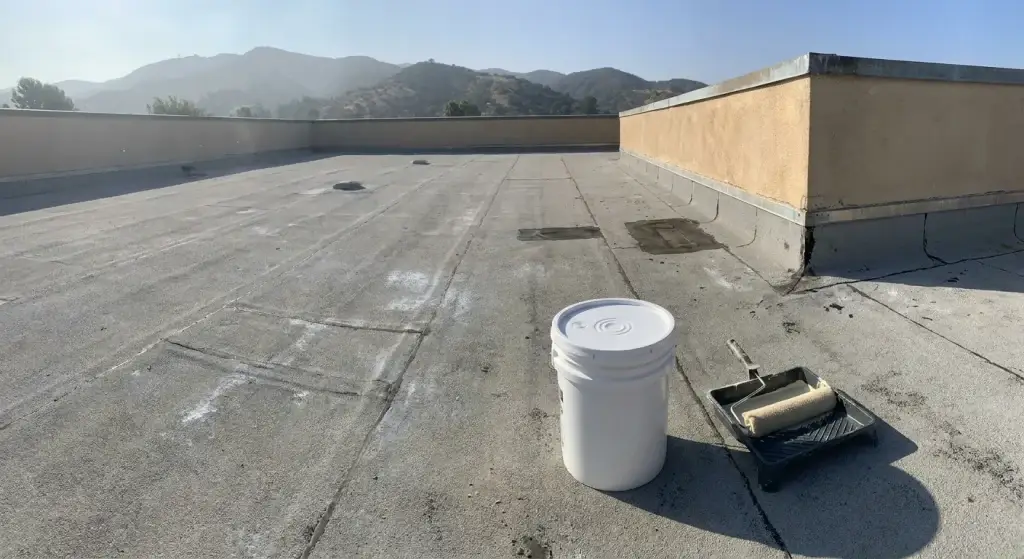
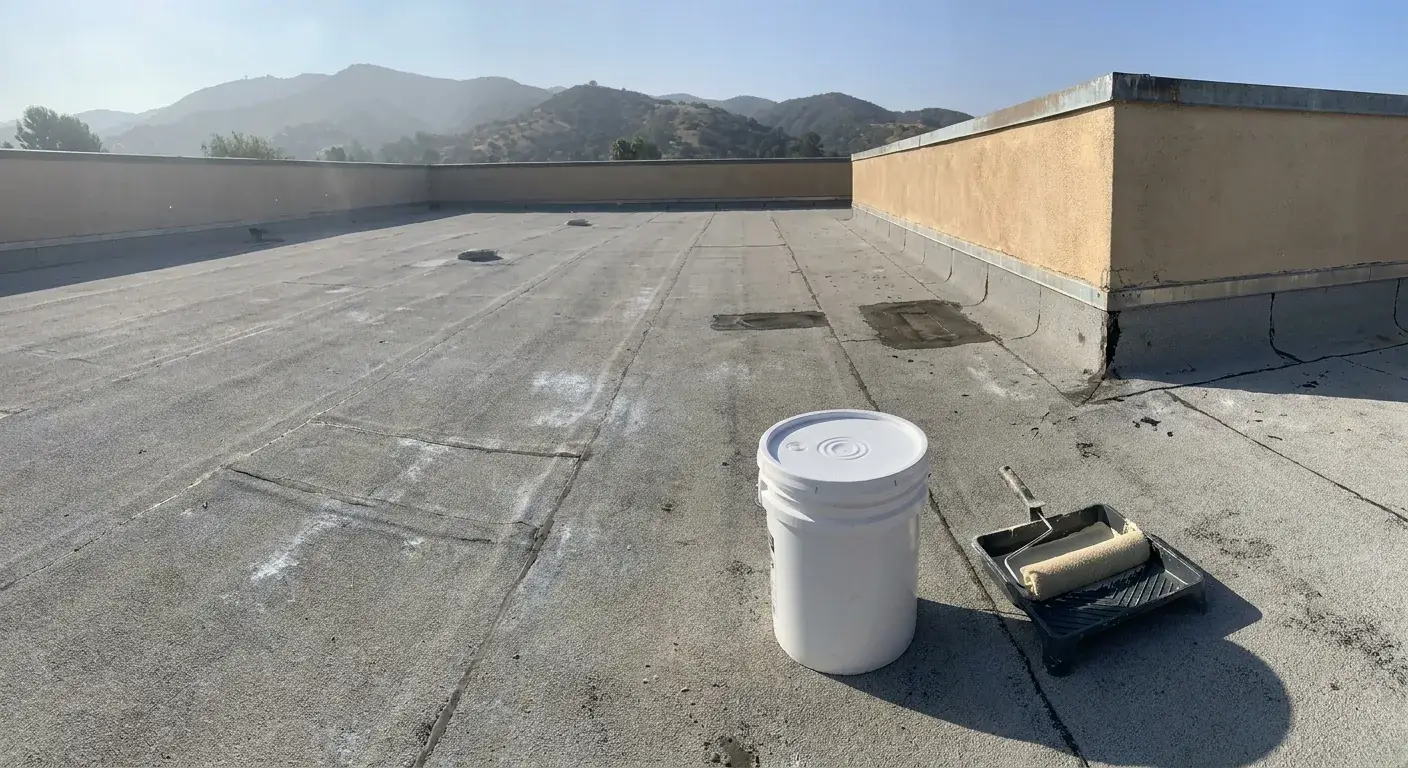
Most roofs that get coated are not broken. They are tired. The seams still hold, the deck is solid, and the surface has chalked down to a dull gray after fifteen summers of Southern California sun. That roof is the one an elastomeric coating can genuinely help. A roof with a fresh ceiling stain underneath it is a different conversation, and so is a roof that feels soft underfoot. Telling those two apart is most of the decision. It starts with knowing what the coating actually is.
On this page
- What elastomeric roof coating is and who needs it
- Coating vs. paint, sealant, and sheet membrane
- How to decide whether your roof is a coating candidate
- Can I coat a roof that leaks, or am I just painting over the problem?
- Can you put elastomeric coating over shingles, EPDM, TPO, metal, or an old coating?
- Acrylic, silicone, and polyurethane: what matters most
- How many gallons do you really need for a roof coating job?
- What it costs
- Is it worth it? Coating vs. recover vs. tear-off
- How long it lasts, when to recoat, and what maintenance it needs
- When to hire a pro
- How to read a coating bid and its warranty
What elastomeric roof coating is and who needs it
Elastomeric roof coating is a liquid-applied membrane rolled or sprayed over an existing roof. It cures into a seamless, rubber-like skin that stretches and relaxes as the roof heats, cools, and moves. Most are white or light colored to reflect sun. It restores and protects a sound roof surface. It does not replace a roof. It does not repair what is failing underneath.
The word elastomeric describes measured behavior. Better systems go well past that floor, with some products stretching 300% to 600% of their original length without cracking. That stretch is what lets a coating ride out the daily expansion and contraction that opens hairline cracks in a rigid surface.
The roofs that suit this work share a profile. They’re aging but stable, dry underneath, and still doing their job.
- Low-slope and flat roofs, including the flat sections over garages, additions, and mid-century homes common across the San Fernando and San Gabriel Valleys.
- Metal roofs with sound panels and tight fasteners, where coating buys years of rust protection.
- Modified bitumen and built-up roofs that have chalked, dried out, or lost their granule surfacing but still shed water.
- Previously coated roofs that have thinned to the point of needing a maintenance recoat.
- Commercial low-slope roofs where a tear-off would shut down operations for a week.
- Concrete decks and small structures like RV roofs, sheds, and patio covers.
The common thread is restoration instead of replacement.
Quick summary:
– Elastomeric coating is a flexible, seamless membrane applied as a liquid over an existing roof.
– It works on roofs that are old but structurally sound and dry.
– It extends service life, not the structure or the deck.
Coating vs. paint, sealant, and sheet membrane
Four different products get mixed up here, and each one solves a different problem.
| Product | What it is | Good at | Watch out for |
|---|---|---|---|
| Elastomeric roof coating | A liquid rolled or sprayed on site that cures into one seamless film, usually 20 to 40 dry mils in two coats | Restoring a sound roof, UV protection, reflectivity, bridging small cracks | Has to match the substrate, the slope, and the drainage |
| Sheet membranes (EPDM, TPO, PVC, modified bitumen) | Factory-made rolls fastened or glued down over the deck | A full new roof surface after a tear-off | A seam at every roll edge, plus tear-off and more disruption |
| Elastomeric wall paint | A thick exterior coating made for stucco and masonry walls | Hairline cracks on vertical surfaces | Built for walls, without the standing-water or roof-grade sun rating |
| Roof sealant or caulk | Mastic or caulk in a tube or pail | Spot repairs at a fastener, a seam, or a pipe boot | Fixes one spot and covers no field area |
The short version: a coating arrives as a liquid and ends up seamless, a sheet membrane arrives in rolls and ends up with seams, wall paint belongs on walls, and sealant fixes one spot.
How to decide whether your roof is a coating candidate
Your roof is a coating candidate when it passes four checks. All four have to pass before anyone prices a product.
- The deck and structure are solid. Walk the roof. Soft or springy spots mean wet insulation or a failing deck, and a coating over that only hides it.
- The membrane is attached and stable. Open seams, lifted laps, cracked flashing, and wide blister fields get repaired or cut out first.
- The assembly is dry. No active leak and no saturated insulation. On a roof with leak history, a moisture scan or a roof core gives the answer.
- Water leaves the roof. Nothing standing 48 hours after rain. Water still sitting past that is a slope or drainage defect. Coating does not correct it.
Choose your path
- Path 1: sound and dry, just aged. No leak history, no soft spots, drains clear, surface chalky or faded. Get an adhesion test and a coating spec with a stated dry-film thickness, then price the work.
- Path 2: repairable but aging. Open seams, cracked flashing, rusted fasteners, or a small blister field. Coating still makes sense once the repairs are done, and the repairs belong on the estimate as line items.
- Path 3: active leak, or a history of leaks. Find the entry point first. A moisture scan or a roof core tells you whether the insulation under the membrane is wet. Wet insulation gets cut out before anything is coated.
- Path 4: ponding water. Correct the drain, the scupper, or the slope before you pick a product. A ponding-rated coating lowers risk. It does not move water.
- Path 5: warranty-sensitive roof. If the membrane is still under a manufacturer warranty, call the manufacturer before a coating touches it. Approved products, approved primers, and approved applicators are usually spelled out.
- Path 6: past saving. Rotten decking, saturated insulation, or widespread delamination. That roof needs replacement, and a coating over it buys nothing.
Prep decides the outcome more than chemistry does. A modest coating over a clean, dry, well-prepared roof outlasts a premium coating over contamination every time. For the prep each surface needs, see the substrate table below, and for whether the work pays off on your particular roof, see coating vs. recover vs. tear-off below.
Can I coat a roof that leaks, or am I just painting over the problem?
Coating cannot solve four conditions: saturated insulation, rotten decking, widespread blistering or delamination, and failed structural slope. Those roofs need repair or replacement. A film over them only hides the evidence.
A coating does not fix a leak. The leak gets traced and repaired first, and the coating goes over a dry, sound roof afterward. Pinholes, hairline cracks in an aged cap sheet, a split seam, and corrosion around a metal roof fastener are the kinds of surface defects that get repaired and fabric-reinforced before any coat goes on.
Water rarely enters where it drips. It travels along a seam, down a slope, across the top of insulation, and drops through the first gap it finds in the ceiling below. That’s why leak work starts with tracing the path, not with buying material. A water test on the suspected area, a look at the flashing where the roof meets a parapet or a stucco wall, and a probe of the deck around the stain usually settle it in an hour. Coating before that tracing happens makes the next diagnosis harder, because the film covers the clues.
Wet insulation is the usual deal-breaker. Restoration screens commonly reject or limit coating when wet insulation covers more than 10 to 25 percent of the roof, confirmed with an infrared survey and core samples. Smaller wet areas get cut out and replaced before coating. Widespread saturation means the roof gets replaced.
So, can you coat a roof with a leak history? Only after the leak is found and repaired and the roof underneath is dry. A coating then protects that roof from sun and heat, and it will not fix a problem you haven’t found yet.
Can you put elastomeric coating over shingles, EPDM, TPO, metal, or an old coating?
Compatibility runs surface by surface. Almost every surface needs a primer, a cleaning standard, or both. The manufacturer’s data sheet for your exact substrate is the document that matters. A label that says it bonds to anything is a marketing claim. Shingles are usually a no, because a shingle roof is built to breathe and a sealed film traps moisture in the mat and under the laps. That moisture shows up later as curling, blistering, and rot you can’t see.
| Substrate | Can it be coated | What it needs first |
|---|---|---|
| Modified bitumen, built-up asphalt | Usually yes | Power wash, loose granules removed, bleed-blocking primer |
| Metal | Yes, common | Rust treated or wire-brushed, rust-inhibiting primer, seams and fasteners fabric-reinforced |
| EPDM | Yes, with the right system | Full wash for talc and oxidation, EPDM-specific primer |
| TPO | Sometimes | Product-specific adhesion test, manufacturer-approved primer |
| Concrete deck | Usually yes | Laitance and efflorescence removed, moisture test, primer |
| Existing acrylic | Usually yes | Wash, chalk removal, adhesion test |
| Existing silicone | Only with a silicone-compatible product or a dedicated primer | Written confirmation from the coating manufacturer |
| Asphalt shingles | Usually no | Trapped moisture under the laps; coat only where the product data sheet names shingles and the roof is dry and sound |
Three checks settle the question before material gets ordered. Run a product-specific adhesion test. Clean and coat three or four two-foot squares in different areas, cure them the full time on the data sheet, cross-hatch one with a razor, and pull tape across it. One major manufacturer’s benchmark is 2.0 pounds per linear inch, and the failure should happen inside the coating or the substrate. A patch that peels off cleanly like a strip of tape tells you the full roof would too. Confirm the primer the manufacturer names for that substrate, since a skipped primer is the most common adhesion failure on single-ply. Then run a moisture check, because an adhesion test on a wet assembly gives you a false pass and trapped moisture shows up later as blisters.
Getting that assessment done before you buy material is worth a phone call. Foothill Painting does on-site free estimates that include looking at what is actually on your roof.
Acrylic, silicone, and polyurethane: what matters most
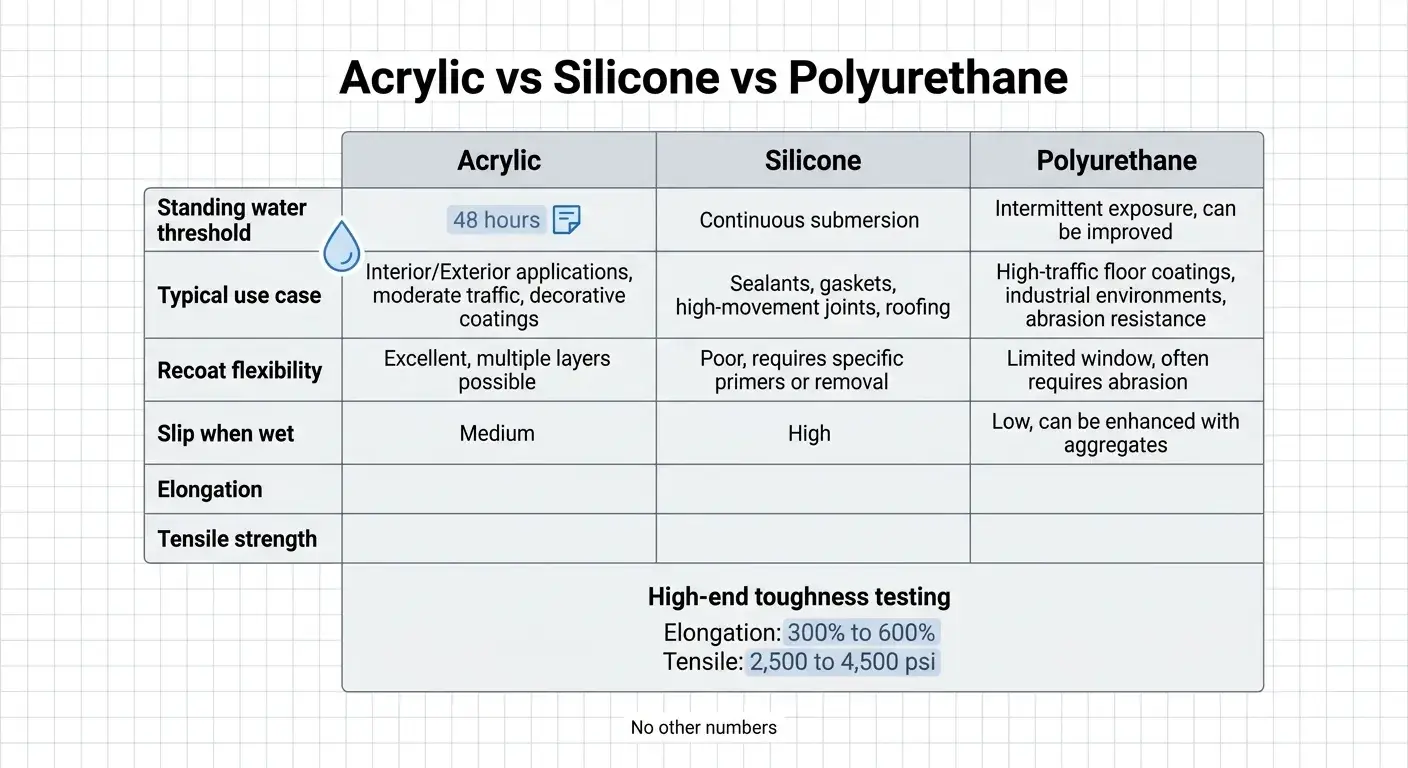
These three chemistries differ most in how they handle standing water, how much abrasion they shrug off, and how they age in sun. Acrylic is water-based, highly reflective, breathable, easy to recoat, and the common choice for sloped and well-drained roofs. Silicone sheds standing water and holds up to UV without chalking much, but it’s slick when wet and nothing else bonds to it later. Polyurethane trades some reflectivity for toughness, which is why it shows up on roofs with foot traffic, rooftop equipment, or hail exposure.
Standing water is the line that separates acrylic from silicone. The Roofing Brief reports that acrylic elastomeric coatings re-emulsify when standing water sits on them for more than 48 hours. On a roof with real drainage, that never comes up. On a roof with a low corner that holds a puddle for three days after every storm, it comes up every winter. That is the roof where a silicone roof coating earns its higher material cost. Premium polyurea and polyurethane systems sit at the other end of the toughness scale, routinely testing at 300% to 600% elongation and 2,500 to 4,500 psi tensile strength.
Color is a real decision, not a style one. White reflects, which keeps the membrane cooler and slows UV aging of everything beneath it. An elastomeric roof coating black or dark enough to match a visible roofline gives up most of that reflectivity and runs hotter, which shortens film life. Pick dark only where the roof is seen from the street and the heat tradeoff is understood.
Standards follow the chemistry. Acrylic roof coatings are commonly tied to ASTM D6083, silicone to ASTM D6694, and polyurethane to ASTM D6947. Meeting a standard means a product passed defined tests. Whether it belongs on your roof still comes down to substrate, slope, and drainage, and the standard leaves thickness, coverage, and cure limits to the product data sheet. Silicone also has a recoat catch: acrylic will not bond to it, so once a roof goes silicone it generally stays silicone. For how to tell a full-thickness acrylic bid from a thin one, see how to read a coating bid below.
How many gallons do you really need for a roof coating job?
Gallons come from the specified wet-film thickness, not from square footage alone. Work from the data sheet, which states an application rate per 100 square feet at a target mil thickness. Wet film is what you put down. Dry film is what’s left after the water leaves. The warranty is written against the dry number. Here is a 1,000 square foot roof at four different specs:
- One coat, light spec. 1.25 gallons per 100 square feet, roughly 20 wet mils and 18 dry mils, is 12.5 gallons.
- One coat, heavy spec. 2.5 gallons per 100 square feet, roughly 40 wet mils and 38 dry mils, is 25 gallons, five full pails. Same roof, same product, double the material, because the required film doubled.
- Two-coat system total. A base coat at 1.25 gallons per 100 square feet plus a topcoat at the same rate is 25 gallons, and roofing elastomeric systems commonly land in the low tens of dry mils once both coats cure.
- Texture and seams added. On a granulated cap sheet, add 20% to the base coat for porosity, and figure fabric-reinforced seams, curbs, and penetrations at two to three times the field rate. With 200 linear feet of detail work, that two-coat total moves from 25 gallons to roughly 33, six or seven pails, with about 10% left over for overspray, roller loss, and pail residue.
That’s why one five-gallon pail can mean very different installed coverage from one roof to the next. A porous granulated surface drinks the first coat, detail work at seams and penetrations eats material fast, and a spec written at 38 dry mils instead of 18 doubles the order before anyone picks up a roller. Published coverage figures run from about 160 to 500 square feet per pail for exactly those reasons. Ask for gallons and target dry-film thickness in writing, because a low per-square-foot price usually means a thin film.
Measure the applied film while it’s wet with an inexpensive wet-film gauge. A uniform white roof can still be 12 mils in the middle of a field where the spec called for 20.
What it costs
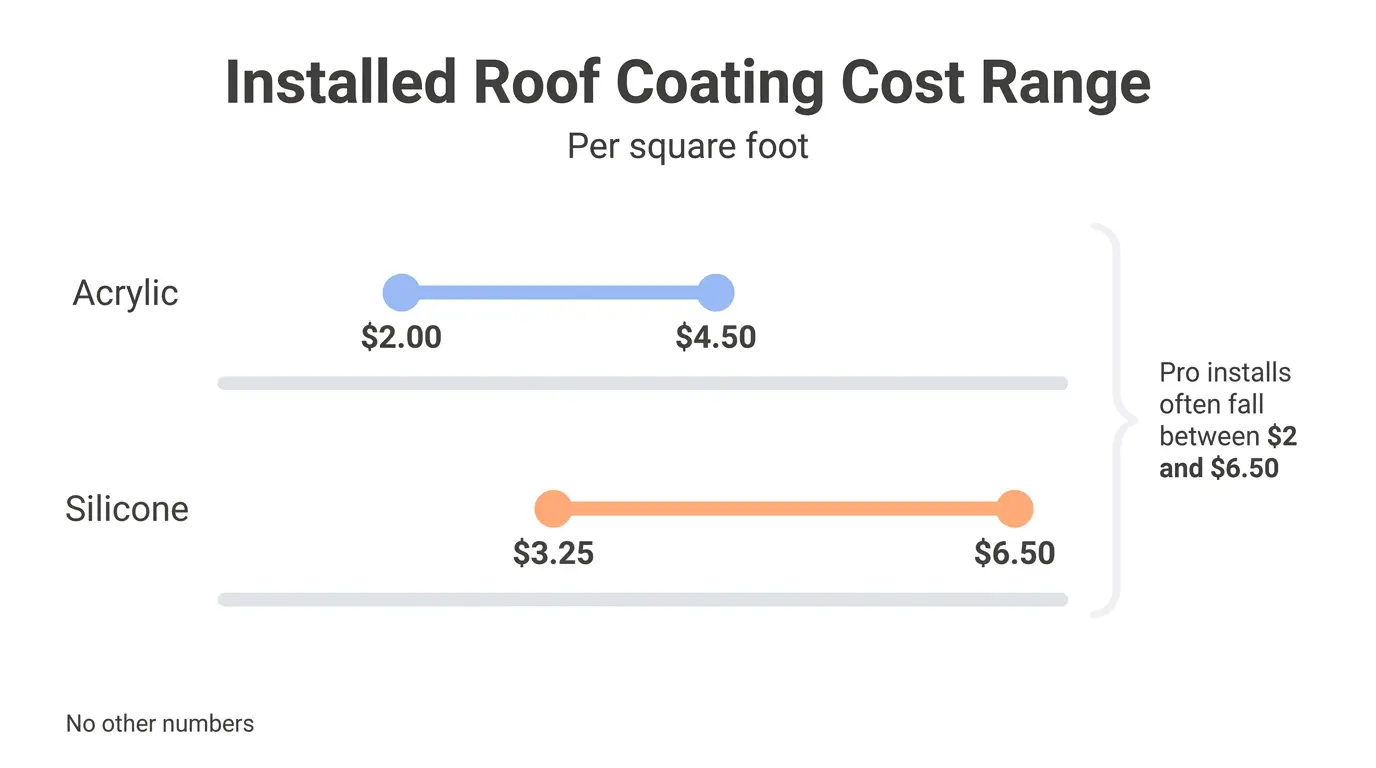
Professional elastomeric roof coating usually falls between $2 and $6.50 per square foot installed, based on published 2026 industry pricing. On a 5,000 square foot planning basis, acrylic elastomeric coating is priced at $2.00 to $4.50 per square foot, while silicone roof coating is priced at $3.25 to $6.50 per square foot. Where your roof lands in that band comes down to the variables in the table, so read any quote against these rows before you compare it to another one.
| Price driver | Lower end | Higher end |
|---|---|---|
| Coating chemistry | Acrylic system, near the bottom of the range | Silicone or polyurethane system, near the top |
| Prep and repairs | Wash only on a clean, sound roof | Seam fabric, flashing rebuilds, rust treatment, wet insulation cut-out |
| Primer | None required after adhesion testing | Substrate-specific primer or bleed blocker across the full roof |
| Roof access | Single story, open roof, ladder access | Multi-story, lift or crane, rooftop equipment, occupied building |
| Thickness target | One coat around 20 dry mils | Two or three coats at 40 dry mils and up |
| Warranty scope | Contractor labor warranty | Manufacturer system warranty with required inspections |
Is it worth it? Coating vs. recover vs. tear-off
Coating pays off on a roof that is dry, structurally sound, and sheds water within 48 hours of a rain. It is a poor bet on a roof that ponds for days, holds wet insulation, or leaks in more places than you can count. Over 10 or 20 years, a sound roof coated once and recoated once usually costs well under a full reroof. A failing roof coated anyway often ends up paying for both.
| Option | Typical installed cost | Time and risk | What you get |
|---|---|---|---|
| Acrylic coating | About $1.50 to $3.00 per sq. ft. | 2 to 4 days; fails early if moisture or ponding is missed | 7 to 15 years, limited material warranty |
| Repair plus coating | About $2.50 to $5.00 per sq. ft. | Longer prep; moisture survey and adhesion test needed | 10 to 15 years on a sound roof |
| Recover | About $4 to $7 per sq. ft. | Adds weight; only allowed over a dry, single existing layer | 20 to 25 years, new membrane warranty |
| Full tear-off | About $7 to $22 per sq. ft. | Open deck, disposal, the most disruption | 25 to 30 years, full system warranty |
These are planning bands for comparing options, and they come from a different set of sources than the cost table above, so expect the coating rows to overlap with it rather than match it to the penny.
Worked example, per square foot. A $2.50 coating that lasts 10 years costs $0.25 a year. Add a recoat at year 10 at about half the original price, and 20 years of coverage costs $3.75, or about $0.19 a year. A $10 replacement that lasts 25 years runs $0.40 a year. Coating wins that math only on a roof that stays dry and drains. Headline quotes often leave out seam reinforcement, primer, moisture testing, and drainage work, and those line items close the gap fast.
Three questions settle most roofs:
- Does it drain within 48 hours? Check after the next rain, or run a hose on a dry day and come back.
- Is it dry? An infrared scan and a few cores answer this. A look from the ladder does not.
- Can the existing roof live out the coating’s term? A 10-year coating over a membrane with three years left is money spent twice.
Three yeses mean coat. A no on drainage means repair plus coating. A no on dryness or remaining life means recover or tear off. One no turns the coating into the most expensive option on the table.
How long it lasts, when to recoat, and what maintenance it needs
Service life is a range rather than a number. You’re looking at roughly 8 to 20 years before a full recoat on a properly specified system. Four things decide where a roof lands in that range. Film thickness comes first, since the warranty is written against dry mils and a thin coat wears through early. Then climate and UV exposure, then ponding water, then maintenance. A thin film on a roof that ponds and never gets cleaned can fail inside five years. A full-thickness system on a roof that drains and gets inspected reaches the long end. Manufacturer warranties run in 5, 10, and 15 year terms and are tied to applied thickness and to inspections actually being performed, which tells you what the manufacturer thinks drives service life.
Inspect twice a year and after any storm that drops debris, and clear the drains and scuppers each time. The recoat triggers are specific. Field thickness worn down, chalking heavy enough to leave white on your hand, film thinned enough to show the substrate color, or reflectivity lost to dirt and algae. A maintenance coat at that point costs far less than starting over, because the prep is a wash instead of a restoration. If you’re weighing whether this approach pays off on your particular roof, the coating vs. replacement math above walks through it.
When to hire a pro
Hire a professional whenever the roof has water in it, water on it, or a warranty attached to it. A small, dry, single-story flat roof with safe access and no leak history is within reach for a careful homeowner. Past that, the diagnostic work and the fall exposure outweigh the labor savings.
The cases that call for a contractor:
- Any active leak or history of leaks. Someone has to find the source and confirm the assembly is dry before coating goes down.
- Ponding water. The fix is drainage correction, tapered insulation, or a drain repair, all of which are trade work.
- Suspected trapped moisture. Infrared scanning and core sampling are the tools. Reading the results takes experience.
- Steep, tall, fragile, or cluttered roofs. Fall protection is a legal requirement on commercial work and a practical one everywhere else.
- Complex penetrations. Curbs, pitch pans, scuppers, parapets, skylights, and HVAC stands are where most coatings fail first.
- Manufacturer warranty requirements. System warranties require an approved applicator, documented thickness, and a final inspection.
- Commercial and multifamily roofs. Tenant coordination, night and weekend scheduling, and phased work all change the plan.
- Older roofs with unknown layers. Asbestos-containing materials turn a simple job into a regulated one.
Get a roof inspection and a written scope before any material is purchased. The inspection should document substrate, roof age, drainage, moisture condition, flashing, seams, penetrations, and any existing coating. That record is what the scope is built from.
Ask every contractor for the same six items in writing, then compare bids line by line:
- Cleaning method, and the condition the roof has to reach before coating.
- Itemized repairs, listed as line items instead of a vague allowance.
- Primer by name, and whether adhesion testing was performed.
- Coating product and number of coats.
- Target dry-film thickness, and how it will be verified.
- Warranty terms, exclusions, and any required inspections.
A bid missing those is a bid you can’t compare to anything.
How to read a coating bid and its warranty
Two quotes for the same roof can differ by thousands of dollars because one includes moisture testing, seam work, and enough coating to reach warranty thickness, while the other quietly skips all three. “Two coats” alone tells you nothing, since a thin coat and a full coat both count as one. When you stack bids side by side, convert each one to total gallons per 100 square feet and total dry mils. A bid that is cheaper per square foot is often just thinner.
Most coating jobs carry two separate warranties. Ask for both in writing.
| Manufacturer warranty | Contractor workmanship warranty | |
|---|---|---|
| Issued by | Coating maker | Installer |
| Usually covers | Defective material; full-system versions may include labor | Application errors and adhesion failures from poor prep |
| Often requires | Authorized applicator, minimum dry mils, inspection, registration | Following the written scope and any maintenance terms |
| Common exclusions | Ponding water, building movement, pre-existing damage, interior damage, skipped maintenance | Damage from other trades, foot traffic, storms |
Longer manufacturer terms usually require more thickness. Broad planning tiers run about 35 dry mils for 10 years, 40 for 15, and 45 for 20, and exact numbers vary by maker and substrate. If a bid promises a term, it should name the mil target that earns it and say whether the contractor is authorized to register it. Many coating warranties are prorated, cover material only, and lapse if ponding develops or required inspections get skipped, so read a 10-year term as coverage for the material under stated conditions.
Check the contractor, too. Look up the license number on the California Contractors State License Board site and confirm it is active and covers the work. Have the contractor’s insurance carrier send the certificate of insurance to you directly, and confirm workers’ compensation is in place, since general liability does not cover an injured worker. Ask for two or three references on similar roofs finished at least a year ago, and call them.
Walk away when you see:
- One lump-sum line with no breakdown of prep, repairs, and coating.
- No product name, no dry mil target, no gallon count.
- On home improvement work, a down payment above 10% of the contract or $1,000, whichever is less, which is the California limit, or payment in full before work starts.
- “Today only” pricing or “the crew’s already in the area” urgency.
- “Your insurance will pay for this,” with no confirmation from your carrier.
- No moisture scan or adhesion test on an older roof.
- “Repair as needed” with no unit prices.
- A price far below every other bid with no clear reason.
Foothill Painting has been family-owned since 1929, working out of a real office at 2134 Floyd St. in Burbank under California contractor license #864996. Every person on your property is a trained, W-2 employee, never a subcontractor or day labor, and every job gets a written contract with fixed pricing and no mid-job upsells. Every job also carries a written warranty plus a follow-up maintenance program that inspects and re-coats on schedule, so the finish and the warranty both stay valid. Estimates are free, done on site, and valid for 30 days, and estimate requests get an answer within 24 hours, usually the same day.
Start with facts about your roof instead of assumptions about the product. Request a free on-site estimate and get the condition and the scope down on paper first.
Have a flat or low-slope roof on an apartment, HOA or commercial building? Foothill Painting applies silicone and acrylic cool roof coatings across Burbank, Glendale and Pasadena with its own W-2 crews. See how we handle roof coatings, or request a free on-site estimate.
Frequently Asked Questions
What are the disadvantages of elastomeric paint?
Elastomeric film is vapor-restrictive, so applying it over damp material traps moisture and the film blisters or lets go. It’s also unforgiving of prep. Chalk, oxidation, or contamination left on the surface shows up as peeling within a season or two. And it adds no structure, slope, or drainage, so it protects a surface without strengthening the assembly underneath.
What is cladding on a roof?
Cladding is a protective outer skin, usually metal or a composite panel, fastened over roof edges, fascia, rakes, or exposed trim. It hardens the roof edge, which is where embers collect in fire zones and where wood trim weathers first. Foothill Painting performs the Trim2Steel installation itself, under the owner’s general contractor license, so the roof edge work and the coating run under one contract and one crew schedule.
Is acrylic roof coating the same as elastomeric?
Not quite. Elastomeric describes a performance property (the ability to stretch and return), while acrylic describes the resin chemistry. Most acrylic roof coatings sold for flat roofs are elastomeric, but some acrylic coatings are rigid films that don’t meet the elongation threshold. Check the data sheet for an elongation value tested to ASTM D412.
What is the best roller to use for applying elastomeric roof coating?
A 3/4 inch nap roller on a heavy-duty frame for smooth membranes, and a 1-1/4 inch nap on granulated, rough, or aged surfaces. Short-nap rollers can’t carry enough material to hit a 20 wet mil target, which is the usual reason a homeowner coat ends up half as thick as the spec. Brush the seams, flashings, and penetrations first, then roll the open field.
How long should I wait between coats, and what happens if rain or dew hits?
Follow the recoat window on the data sheet, which is commonly overnight for acrylics in warm, dry conditions and longer when humidity is high or temperatures drop. Stop applying in time for the film to set before evening dew, since dew on an uncured acrylic can wash it off or leave a soft, chalky surface. Rain on a fresh coat usually means washing the area and recoating it. Watch overnight lows, not just the daytime high.
Is elastomeric roof coating walkable, and can my HVAC tech service equipment on it?
It handles occasional service traffic, but it’s a membrane rather than a wearing surface. It gets slippery when wet. Roofs with regular equipment service should get walkway pads or a higher-build polyurethane traffic coating along the service route. After any work that scrapes or punctures the film, the spot needs cleaning, fabric if the cut is wide, and a patch coat.
Why did my coating peel, bubble, or come off in fingernail-sized pieces?
Almost always adhesion, and adhesion is almost always prep. The usual causes are coating over a surface that was damp, dirty, chalky, oxidized, or still holding mildew, or skipping a primer that the substrate required. Bubbles across a field usually mean moisture trapped in the assembly underneath. The honest fix is removing the failed film in that area, correcting the cause, testing adhesion on a patch, then recoating.
Does applying roof coating void my existing roof warranty?
It can. Membrane manufacturers typically name approved coatings, approved primers, and approved applicators. Work outside that list can end the coverage. Call the original roof manufacturer with the system name and installation date before scheduling anything, and keep the written response. If the roof is out of warranty, this stops being a concern.
Does a white roof coating actually lower cooling costs?
A reflective white surface lowers the roof’s surface temperature substantially in full sun, which reduces heat pushed into the space below. The savings depend on how much insulation sits under the deck, how much of the building is under that roof, and how the air conditioning runs. Reflectivity also fades as dirt accumulates, so an annual wash keeps the benefit closer to day one.
What do wet mils, dry mils, DFT, and WFT mean in a roof coating spec?
A mil is one thousandth of an inch. Wet film thickness, or WFT, is what the coating measures right after application, checked with a notched gauge. Dry film thickness, or DFT, is what remains after the water or solvent evaporates, and it is the number warranties are written against. That is why a spec might call for 16 wet mils to land near 10 dry mils per coat.
Can you paint over elastomeric roof coating?
You can recoat an existing elastomeric coating with a compatible roof coating after cleaning and an adhesion test, which is the normal way these systems are maintained. Silicone is the exception and generally needs a specific primer before anything else will bond to it. Regular exterior paint over a roof coating is a poor idea, since wall paint has neither the stretch nor the water exposure rating a roof needs.
Can I put silicone over acrylic roof coating?
Usually yes, if the acrylic is clean, well bonded, and primed with a product the silicone maker approves. Run a cured test patch and pull it before full application. Going the other way is harder. Acrylic will not bond to silicone, so once a roof goes silicone it generally stays silicone.
How long should a new TPO or asphaltic roof weather before it gets an acrylic coating?
At least 30 days for at least one major manufacturer’s acrylic topcoat. Fresh membranes carry release agents and oils that block adhesion. Even after weathering, the surface needs cleaning and, depending on the product, a primer.
Does the quoted dry mil thickness include reinforcing fabric?
Sometimes, so ask. At least one manufacturer counts about 6 mils for fabric inside its three-course thickness figures. A total that includes fabric may carry less actual coating than a coating-only number.
Does the coating color change what the bid should list?
White reflects the most heat, and most acrylics also come in light grays, tans, and custom tints, with darker colors reflecting less. If cool roof rules apply, such as California’s Title 24 on some low-slope roof work, the bid should name the color and its CRRC rating or ENERGY STAR listing.