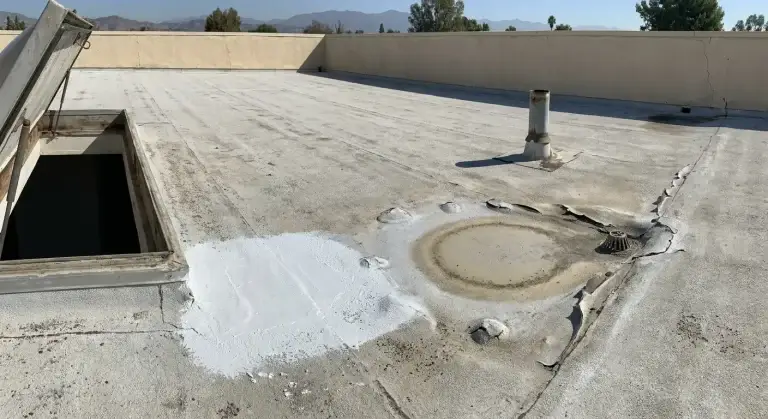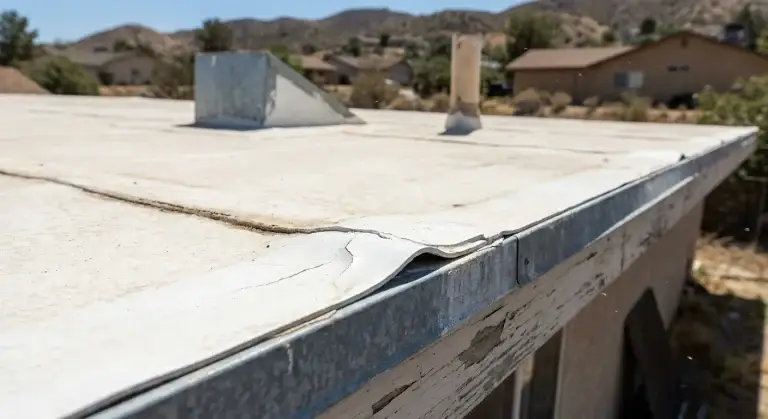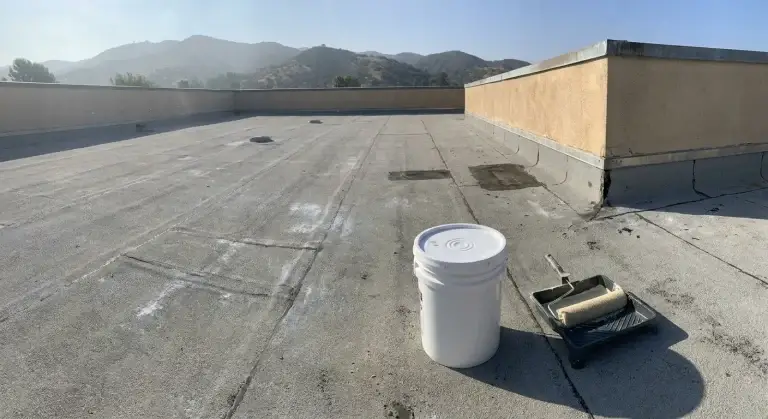
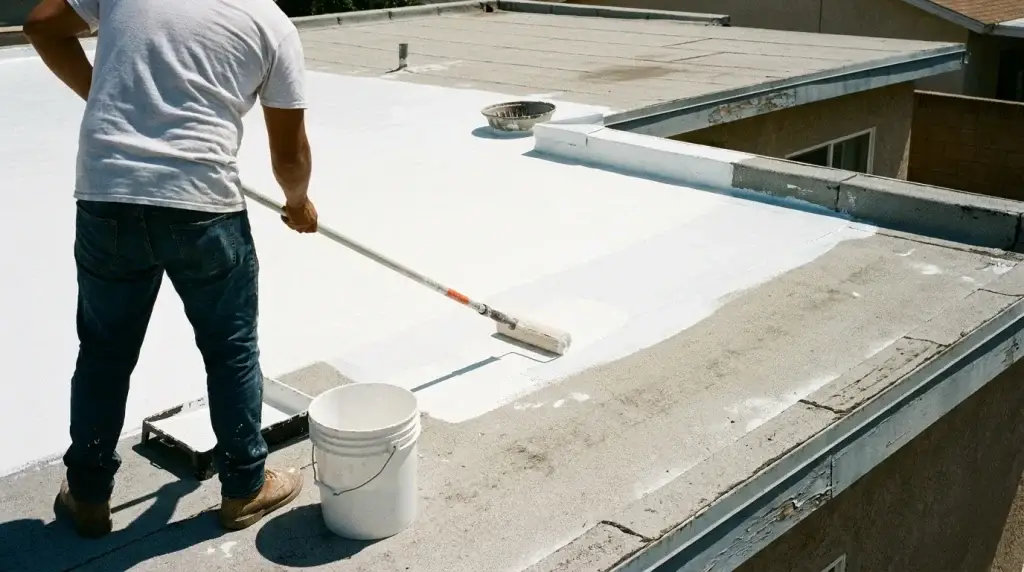
An elastomeric roof coating is a thick liquid you roll or spray over a roof you already have. It dries into a stretchy, rubber-like skin that protects the surface, reflects sunlight, and stretches with the roof instead of cracking. Owners use it to get more years out of a worn but sound flat or low-slope roof.
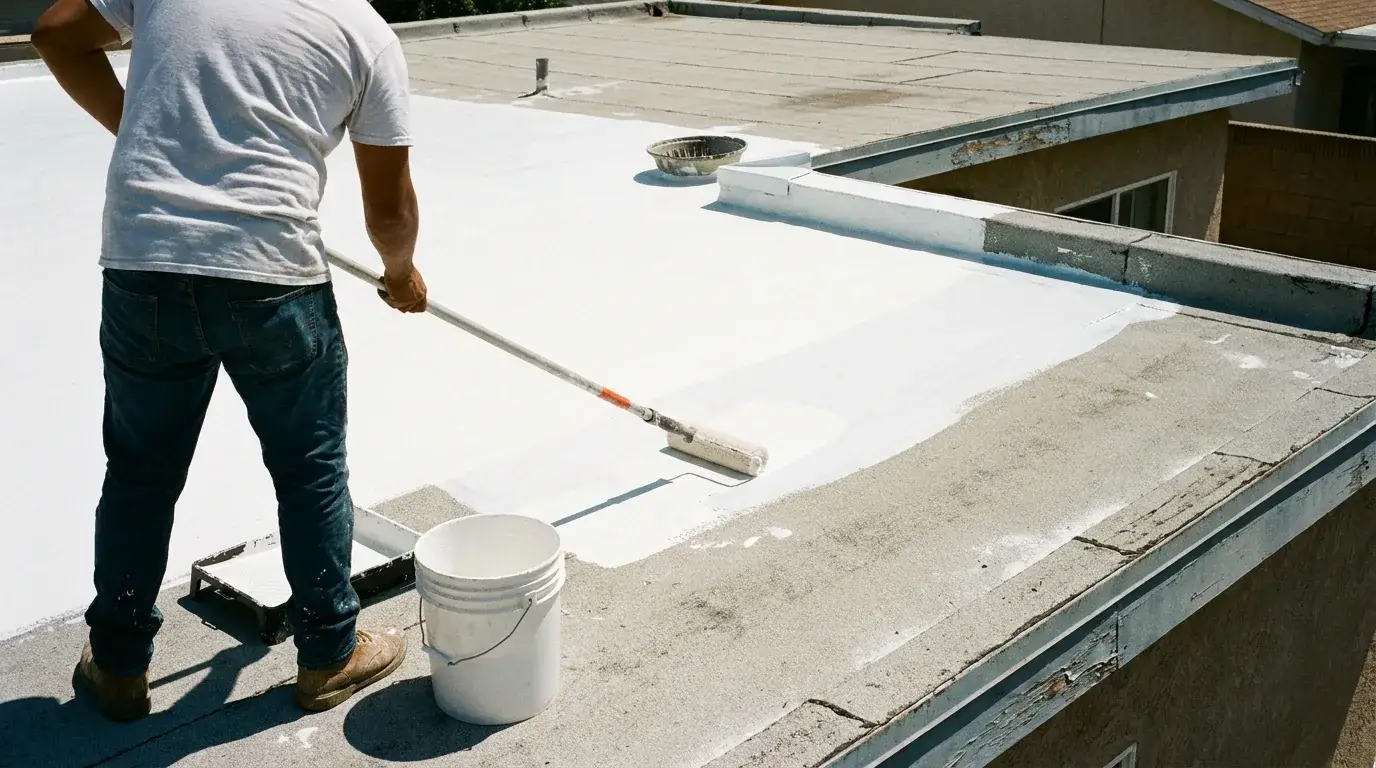
What an Elastomeric Roof Coating Is
Definition: An elastomeric roof coating is a liquid-applied roofing material, usually acrylic, silicone, or polyurethane, rolled or sprayed over an existing roof. It cures into a seamless, flexible film that stretches a lot and recovers, so it moves with the roof instead of cracking.
If you own a flat or low-slope roof, a mid-century home with a flat section, a small commercial building, or an apartment property with a built-up roof, this is the term you will hear first.
How It Works on a Roof
The cured film bonds to the roof and then acts like a thin rubber sheet. It stretches as the roof expands in the heat and pulls back as it cools. Five plain things do the work: it sticks to the surface, it stretches and recovers, it bridges small cracks and seams, it reflects sunlight, and it gives the roof one continuous surface that sheds water toward the drains. Water-based acrylic versions clean up with plain water while they are still wet.
Those properties only show up at the right film thickness. Coating is measured in mils, one mil being one thousandth of an inch. Installers check wet film thickness with a notched gauge during application and aim at a dry film thickness once the water or solvent leaves. A system might call for two coats at roughly 16 wet mils each, with the second coat run across the first so one pass covers the thin spots of the other. Seams, curbs, drains, and penetrations get treated separately, usually with a base coat and embedded polyester reinforcing fabric, because those spots move more and leak more than the open field of the roof.
Spread rate and adhesion decide the rest. A clean, dry surface, a pull test on the cleaned roof, and the primer the manufacturer names for that substrate are the reason one film holds for years and another peels in sheets. Foothill Painting uses Dunn-Edwards and Sherwin-Williams paint only, applied at the manufacturer’s specified spread rate and never thinned, which is what qualifies the customer for the full manufacturer paint warranty.
Worked example: how many gallons a 2,000 square foot roof takes
Warranty-level systems commonly run about 1.5 to 2.5 gallons per 100 square feet per coat. At 2 gallons per 100 square feet, a 2,000 square foot roof takes 40 gallons for the first coat and 40 for the second, so 80 gallons, or 16 five-gallon pails. Add about 10% for waste, rough surfaces, and the heavier base coat at the seams and you are ordering closer to 88 gallons.
Raise the target thickness for a longer system warranty and the rate climbs toward 2.5 gallons per 100 square feet. That turns the same roof into 100 gallons before waste. A silicone system over asphalt can be specified near 2.5 gallons per 100 square feet to land around 38 dry mils in one pass, so chemistry moves the total as much as area does. Cut to one thin coat and you get a film that looks finished and performs like paint.
Example: a metal roof on a hot afternoon
A white-coated metal roof over a valley warehouse heats up through the morning and the panels grow. The seams open slightly, the fasteners shift, and the cured film stretches across each seam and fastener head instead of splitting. After sunset the panels contract and the film recovers. A rigid coating, or an elastomeric film applied too thin over a rusty panel, would crack at that same seam within a season or two.
White is the default finish for a reason. A bright white film reflects most of the sunlight that lands on it. Manufacturers commonly claim up to 90% of the sun’s rays, with published comparisons putting the coated surface more than 40 degrees cooler than a dark roof under the same sun. Solar reflectance and thermal emittance are measured separately, so a product can be strong at one and ordinary at the other.
When Elastomeric Roof Coating Makes Sense
Coating fits an aging roof that is still structurally sound, where the deck is dry, the drainage works, and the damage is weathering rather than failure. That describes a lot of low-slope commercial buildings: warehouses, retail strips, schools, and apartment properties where the owner wants to put off a tear-off without ignoring the roof. Specified systems are used over metal, smooth built-up roofing, modified bitumen, weathered EPDM, TPO, PVC, concrete, and spray polyurethane foam, with compatibility confirmed in the manufacturer’s technical data for that exact substrate.

Not every roof or slope qualifies. Steep-slope asphalt shingles are generally not a coating candidate, whatever a big-box label suggests. Drainage sets the chemistry before you pick a brand.
Acrylic is water-based and wants the water off the roof within a day or so, since spots that stay wet can soften or erode the film. Silicone is the better option where ponding is permanent and the drainage cannot be corrected. In dry, high-sun Southern California weather, a reflective acrylic over a roof that drains is the common pick. One shaded low spot that holds water every winter can move the whole job to silicone.
Substrate changes the prep, the primer, and the thickness:
| Substrate | Prep step | Primer | Typical dry mils per coat |
|---|---|---|---|
| Metal | Remove rust, reseat or replace fasteners, detail the seams | Rust-inhibitive primer over bare and treated metal | About 8 |
| Smooth BUR | Wash off dirt and loose asphalt, repair blisters and open plies | Bleed-blocking primer so asphalt does not stain the film | About 16 |
| Modified bitumen | Clean, cut and reset fishmouthed laps, deal with loose granules | Bleed-blocking primer, heavier rate on granulated surfaces | About 16 |
| Weathered single-ply (EPDM, TPO, PVC) | Wash, then run an adhesion test on the cleaned membrane | Usually required, since aged sheets carry plasticizers and chalk | About 12 |
| Spray polyurethane foam | Repair open cells and blisters, then recoat on schedule | Often none, per the system data sheet | Per the silicone or acrylic system spec |
Those thickness figures come from one manufacturer’s data for one acrylic system, so read the technical data sheet for the product you are buying. According to ASTM International, ASTM D6694 covers a liquid-applied, solvent dispersed elastomeric coating used as a roofing membrane for spray polyurethane foam insulation, with a principal polymer that is more than 95% silicone.
A roof that can be restored looks like this: a 15-year-old modified bitumen deck with surface alligatoring, chalked granules, a few open laps, and no wet insulation on a moisture scan. Clean it, repair the laps, prime it, coat it, and the roof buys years.
A roof that cannot looks like this: a flat roof with soft spots underfoot, stained ceilings in three rooms, and core cuts that come up with saturated insulation. Coating that roof seals the problem under a new film and hides the deterioration until the repair bill grows.
Active Leaks, Ponding Water, and Compatibility Questions
The decision rule: coat a roof that leaks a little because it is worn, repair or replace a roof that leaks because something failed. A coating bridges hairline cracks, tired laps, and weathered surfaces. It will not correct saturated insulation, rotted decking, failed flashing, or a roof with no positive drainage.
Repairs that belong before the coating goes on:
Flashing and terminations. Base flashings, parapet caps, and counterflashing get repaired or replaced first. These are the most common leak source and the hardest for a field coat to fix.
Seams and laps. Open or fishmouthed seams get cut, reset, and reinforced with fabric in a base coat before the field is coated.
Fasteners and penetrations. Backed-out screws, failed pipe boots, loose curbs, and skylight details all need mechanical repair.
Drains and scuppers. If water sits for days, fix the drainage. Clearing a blocked drain is cheaper than premature coating failure.
Wet insulation. A moisture scan or core cuts tell you what is under the surface. Wet areas get cut out and replaced. Coating over them traps the water.
Ponding is its own conversation. Acrylic systems are water-based and generally want positive drainage. Silicone handles standing water far better and is the usual choice when drainage cannot be corrected, though it picks up dirt, loses some reflectivity over time, and needs a specific primer before anything is recoated over it. The head-to-head tradeoffs are covered in “silicone vs acrylic roof coating.”
Why coatings peel even though the label says they bond. Adhesion is earned on the roof, not promised on the pail. Four things cause most peeling.
First, dirt: the surface has to be free of grease, oil, mold, algae, chalk, rust, loose granules, and loose old paint, which usually means a wash and sometimes a scrub or a rust treatment.
Second, moisture: a membrane that is still damp, or wet insulation underneath, pushes vapor up into the curing film and lifts it in blisters and sheets.
Third, primer: aged single-ply carries plasticizers and chalk, bare metal needs a rust-inhibitive primer, and asphalt bleeds through without a blocking primer.
Fourth, the old coating: a new product over an unknown existing film can let go right at the line between the two. That is what an adhesion test is for. Coat a small patch on the cleaned roof, let it cure, and pull it. If it comes off in fingernail-sized pieces, the prep, the primer, or the product match is wrong.
If you want a straight read on which category your roof falls into, a free on-site estimate starts with looking at the flashings and the drains, not the color.

Common Confusions: Coating, Paint, Sealant, and Membrane
People mix up four different products here.
| Term | What it is | Good at | Watch out for |
|---|---|---|---|
| Elastomeric roof coating | A liquid rolled or sprayed on site that cures into one seamless film, 20 to 40 dry mils in two coats | Restoring a sound roof, UV protection, reflectivity, bridging small cracks | Has to match the substrate, the slope, and the drainage |
| Rubber roofing and other sheet membranes | Factory-made EPDM, TPO, PVC, or modified bitumen rolls, fastened or glued down over the deck | A full new roof surface after tear-off | A seam at every roll edge, tear-off, more disruption |
| Elastomeric wall paint | A thick exterior coating made for stucco and masonry walls | Hairline cracks on vertical surfaces | Not built for standing water or roof-grade sun exposure |
| Roof sealant or caulk | Mastic or caulk in a tube or pail | Spot repairs at a fastener, a seam, or a pipe boot | A patch, not a system, and it covers no field area |
The short version: a coating arrives as a liquid and ends up seamless, a rubber roof arrives as sheets and ends up with seams, wall paint belongs on walls, and sealant fixes one spot.
Inside the coating category, the binder is the difference. Acrylic is water-based, bright white, easy to clean up with water, and it wants a roof that drains. Silicone shrugs off standing water and cures in humid weather, but it holds dirt and needs its own primer before anything goes over it. Polyurethane is the tough one, with better resistance to foot traffic and hail.
Standards follow the chemistry. Acrylic coatings are commonly tied to ASTM D6083, silicone to ASTM D6694, and polyurethane to ASTM D6947. ASTM International reports that the silicone standard is referenced in the 2012 International Building Code and the International Residential Code. Meeting a standard means a product passed defined tests. It does not mean the product belongs on your roof.
What to Do Next
Your next decision is an inspection, not a product. Walk the roof or have someone walk it, check the flashings, seams, drains, and whether the insulation is dry, then confirm in the manufacturer’s data that the coating you are considering is approved for your substrate, with the right primer and the right spread rate.
From there the path splits. If you are picking a chemistry, “acrylic roof coating” and “silicone vs acrylic roof coating” cover the selection criteria. If you are weighing whether restoration pays off on your building, “acrylic elastomeric roof coating” works through that call. If you plan to do the work yourself, “how to apply elastomeric roof coating” covers prep, weather windows, and application. Installed restoration systems commonly run about $2 to $5 per square foot, and the full breakdown sits in “Elastomeric Roof Coating: The Complete Guide.”
One last thing most owners learn late: a coated roof is a maintained roof. Foothill Painting backs every job with a written warranty plus a follow-up maintenance program that inspects and re-coats on schedule, so the finish and the warranty both stay valid. Estimates are free, done on site, and valid for 30 days, and every request gets an answer within 24 hours, usually the same day.
When you are ready for a documented look at your roof, request your free estimate.
Frequently Asked Questions
How thick does an elastomeric coating need to be?
Most systems call for a specified dry film thickness, usually 20 to 40 mils applied in two coats. The weak points are pinholes, thin spots at the edges of a spray pass, and untreated seams and penetrations, which is why detailing with reinforcing fabric comes before the field coat. A coating applied at half the specified rate will not perform the way its spec sheet says, whatever it cost.
How long will elastomeric roof coating last?
Most systems are described at 10 to 20 years of service life, with the longer end tied to higher film thickness and scheduled maintenance. Cracks, peeling, chalking, and flaking are the practical recoat triggers, not the date on the warranty paperwork. Roofs with heavy UV exposure and ponding age faster than roofs that drain clean.
What is elastomeric roof coating made of?
The film is built from a polymer binder, usually acrylic, silicone, polyurethane, or a synthetic rubber, carried in water or solvent with pigments and fillers. Acrylics are water-based and bright white, silicones shed standing water and cure in humidity, and polyurethanes trade some reflectivity for toughness. Once the water or solvent leaves, the binder is what stays on the roof, and it decides how far the film can stretch and recover.
Can you color elastomeric roof coating?
Most roof coatings come in white, light gray, and tan, and some manufacturers offer tinted versions. Color costs you reflectivity. A dark roof coating absorbs more solar heat, which raises surface temperature and increases the thermal movement the film has to absorb, so white stays the default on low-slope roofs in hot climates.
Can you paint over elastomeric roof coating?
You can recoat an existing elastomeric coating with a compatible product after cleaning and an adhesion test, which is the normal way these systems are maintained. Silicone is the exception and generally requires a specific primer before anything else will bond to it. Regular exterior paint over a roof coating is a poor idea, since wall paint has neither the elongation nor the water exposure rating for a roof.
What do wet mils, dry mils, DFT, and WFT mean in a roof coating specification?
A mil is one thousandth of an inch. Wet film thickness, or WFT, is what the coating measures right after application, checked with a notched gauge. Dry film thickness, or DFT, is what remains after the water or solvent evaporates, and it is the number warranties are written against, which is why a spec might call for 16 wet mils to land near 10 dry mils per coat.
Is elastomeric roof coating worth it?
It depends entirely on the condition of the roof underneath, since coating a sound roof extends its life and coating a failed roof wastes the money twice. The decision framework, including when restoration beats replacement, is worked through in “acrylic elastomeric roof coating.”